
P12: Compilation and Benchmarking Environment for Trapped-Ion Quantum Computing (ComfortQC)
Members: Prof. Dr. Ferdinand Schmidt-Kaler (JGUM), Prof. Dr. Robert Wille (TUM), David Braune (JGUM), Jurek Eisinger (JGUM), Dr. Janine Hilder (JGUM), Dr. Ulrich Poschinger (JGUM), Ludwig Schmid (TUM), Daniel Schönberger (TUM), Linus Schulte (TUM), Janis Wagner (JGUM)
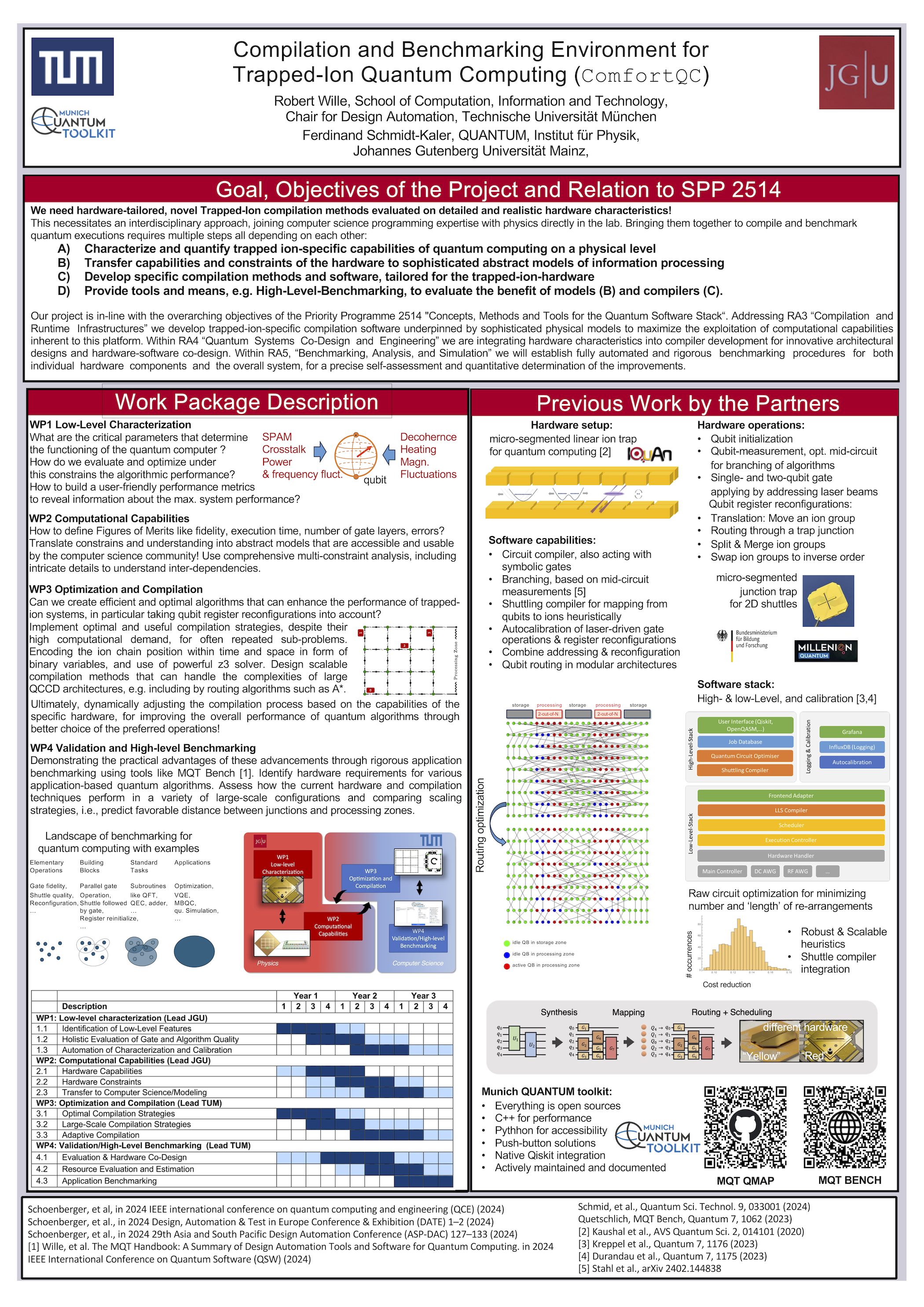
Trapped-ion quantum computers represent a promising platform for achieving quantum computational advantage – demonstrating exceptional performance in qubit entanglement, gate fidelities, coherence times, and versatile qubit register reconfiguration operations. Despite their promising capabilities, the lack of corresponding hardware-adaptive software prevents existing hardware platforms from unleashing their full computational potential. The development of such hardware-tailored software requires close interdisciplinary collaboration between experimental and theoretical physics as well as computer science to fully leverage the unique hardware characteristics of trapped-ion systems. This interdisciplinary research project between the Johannes Gutenberg University Mainz (JGU) and the Technical University of Munich (TUM) aims to provide the basis for a comprehensive software ecosystem specifically tailored to state-of-the-art trapped-ion quantum computing hardware.
The proposed research addresses the challenges through four integrated steps: (1) Identification and characterization of elementary hardware operations, including ion shuttling. (2) Determination of the full set of computational capabilities and constraints of trapped-ion systems and deriving abstract hardware models allowing extensible and reusable software interfaces. (3) Developing optimal and efficient compilation methodologies and providing the results as high-quality open-source software to the community. (4) Using application-driven automated benchmarking procedures to assess and co-design the underlying hard- and software components and tracking improvements of the computational performance throughout the project.
This initiative seeks to provide fundamental building blocks and to lay the groundwork for future community-driven software development, eventually leading to the development of a complete and fully functional software stack. Therefore, we will provide results open-source. The collaborative approach bridges experimental and theoretical physics as well as computer science and combines knowledge resources from both fields to contribute significant theoretical and practical insights as well as tools to the trapped-ion quantum computing community.
Publications
Toolchain for shuttling trapped-ion qubits in segmented traps
A. Conta, S. Bogino, F. Köhncke, F. Schmidt-Kaler, and U. G. Poschinger
2026, AVS Quantum Science, vol. 8, no. 2, p. 023801, DOI: 10.1116/5.0323942.
Alternating ZX Circuit Extraction for Hardware-Adaptive Compilation
L. Schmid, K. Staudacher, and R. Wille
2026, in 2026 Design, Automation & Test in Europe Conference (DATE), Verona, Italy: IEEE, pp. 1–7. DOI: 10.23919/DATE69613.2026.11539068.
Quantum Circuit Compilation for Superconducting Bus-Resonator Architectures
P. Hopf, L. Burgholzer, and R. Wille
2026, in 2026 Design, Automation & Test in Europe Conference (DATE), Verona, Italy: IEEE, pp. 1–7. DOI: 10.23919/DATE69613.2026.11539523.
Focus Session Paper: The MQT Compiler Collection : A Blueprint for a Future-Proof Quantum-Classical Compilation Framework
L. Burgholzer, D. Haag, Y. Stade, D. Rovara, P. Hopf, and R. Wille
2026, in 2026 Design, Automation & Test in Europe Conference (DATE), Verona, Italy: IEEE, pp. 1–7. DOI: 10.23919/DATE69613.2026.11539504.
Integrating Quantum Software Tools with(in) MLIR
P. Hopf, E. Ochoa, Y. Stade, D. Rovara, N. Quetschlich, I. A. Florea, J. Izaac, R. Wille, and L. Burgholzer
2026, in Proceedings of the Supercomputing Asia and International Conference on High Performance Computing in Asia Pacific Region, Osaka Japan: ACM, pp. 42–54. DOI: 10.1145/3773656.3773658.
Heuristics for Shuttling Sequence Optimization for a Linear Segmented Trapped-Ion Quantum Computer
J. Durandau, C. A. Brunet, F. Schmidt-Kaler, U. Poschinger, F. Mailhot, and Y. Bérubé-Lauzière
2026, arXiv. DOI: 10.48550/ARXIV.2603.05464.
Design Automation Tools and Software for Quantum Computing: Inside the Munich Quantum Toolkit
L. Burgholzer and R. Wille
2026. Cham: Springer Nature Switzerland. DOI: 10.1007/978-3-032-06770-8.
Orchestrating Multi-Zone Shuttling in Trapped-Ion Quantum Computers
D. Schoenberger and R. Wille
2025, in 2025 IEEE International Conference on Quantum Computing and Engineering (QCE), Albuquerque, NM, USA: IEEE, pp. 1069–1075. DOI: 10.1109/QCE65121.2025.00119.
Shuttling for Trapped-Ion Quantum Computers with Embedded Processing Zones
D. Schoenberger, J. Hilder, F. Schmidt-Kaler, and R. Wille
2025, in 2025 IEEE International Conference on Quantum Software (QSW), Helsinki, Finland: IEEE, pp. 123–129. DOI: 10.1109/QSW67625.2025.00023.
Shuttling for Scalable Trapped-Ion Quantum Computers
D. Schoenberger, S. Hillmich, M. Brandl, and R. Wille
2025, IEEE Trans. Comput.-Aided Des. Integr. Circuits Syst., vol. 44, no. 6, pp. 2144–2155, DOI: 10.1109/TCAD.2024.3513262.
Sample-Based Krylov Quantum Diagonalization for the Schwinger Model on Trapped-Ion and Superconducting Quantum Processors
E. O. Rosanowski, J. Eisinger, L. Funcke, U. Poschinger, and F. Schmidt-Kaler
2025, arXiv. DOI: 10.48550/ARXIV.2510.26951.
Shuttling Compiler for Trapped-Ion Quantum Computers Based on Large Language Models
F. Kreppel, R. Salkhordeh, F. Schmidt-Kaler, and A. Brinkmann
2025, arXiv. DOI: 10.48550/ARXIV.2512.18021.
Related Publications
Following is a list of papers that are related to ComfortQC. Some of the mentioned papers have been published in previous projects, but are highly related to ComfortQC.
Using Boolean Satisfiability for Exact Shuttling in Trapped-Ion Quantum Computers, D. Schoenberger
S. Hillmich, M. Brandl, and R. Wille
2024, in 2024 29th Asia and South Pacific Design Automation Conference (ASP-DAC), Incheon, Korea, Republic of: IEEE, pp. 127–133. DOI: 10.1109/ASP-DAC58780.2024.10473902.
The MQT Handbook: A Summary of Design Automation Tools and Software for Quantum Computing
R. Wille, L. Berent, T. Forster, J. Kunasaikaran, K. Mato, T. Peham, N. Quetschlich, D. Rovara, A. Sander, L. Schmid, D. Schönberger, Y. Stade, and L. Burgholzer
2024, DOI: 10.48550/ARXIV.2405.17543.
Quantum Circuit Compiler for a Shuttling-Based Trapped-Ion Quantum Computer
F. Kreppel, C. Melzer, D. Olvera Millán, J. Wagner, J. Hilder, U. Poschinger, F. Schmidt-Kaler, and A. Brinkmann
2023, Quantum, vol. 7, p. 1176, DOI: 10.22331/q-2023-11-08-1176.
Automated Generation of Shuttling Sequences for a Linear Segmented Ion Trap Quantum Computer
J. Durandau, J. Wagner, F. Mailhot, C.-A. Brunet, F. Schmidt-Kaler, U. Poschinger, and Y. Bérubé-Lauzière
2023, Quantum, vol. 7, p. 1175, DOI: 10.22331/q-2023-11-08-1175.
MQT Bench: Benchmarking Software and Design Automation Tools for Quantum Computing
N. Quetschlich, L. Burgholzer, and R. Wille
2023, Quantum, vol. 7, p. 1062, DOI: 10.22331/q-2023-07-20-1062.
Shuttling-based trapped-ion quantum information processing
V. Kaushal, B. Lekitsch, A. Stahl, J. Hilder, D. Pijn, C. Schmiegelow, A. Bermudez, M. Müller, F. Schmidt-Kaler, and U. Poschinger
2020, AVS Quantum Science, vol. 2, no. 1, p. 014101, DOI: 10.1116/1.5126186.
| Name | Title | Group | |
|---|---|---|---|
| Schmidt-Kaler, Ferdinand | Prof. Dr. | Johannes Gutenberg University Mainz, Institute of Physics, QUANTUM, Group Leader 'Quantenbit AG' | fsk ∂does-not-exist.uni-mainz de |
| Wille, Robert | Prof. Dr. | TU Munich, School of Computation, Information and Technology, Group Leader 'Design Automation' | robert wille ∂does-not-exist.tum de |